About Egypt’s Book of Mystery Demo: The Top Reel
This is a third-party free-play demo, not real-money play on Demo slot pg. Availability and access checks are controlled by the provider. Demo results do not predict future outcomes.
The free Egypt’s Book of Mystery Demo puts a book-shaped Scatter on an Egyptian-themed board with a separate reel above the middle columns. It also gives two distinct meanings to a symbol transformation: a framed tile can become several Wilds after a cascade, and a separate effect can replace several ordinary pictures before the result settles. The preview uses virtual credits only. No deposits, withdrawals or cash prizes are involved.
Start by finding the book in the symbol guide
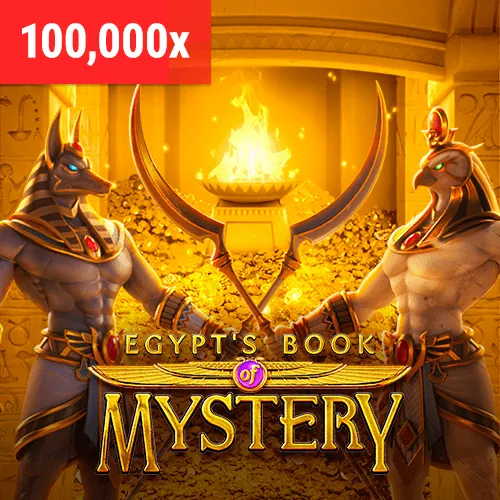
The opening image in PG SOFT’s manual shows two Anubis-like guards facing one another at a temple entrance. Once the playable grid appears, the theme moves into ankhs, scarabs, serpents and eye motifs among character illustrations and familiar ranks. This is an invented treasure story, not an explanation of ancient Egypt. Use those familiar shapes as visual anchors, while taking the game’s named rules from its own information panel.
The title object is not just in the splash art. The manual depicts a purple-and-gold book with an ankh on the cover as the Scatter. It shows a separate gold face tile labeled Wild. The Wild stands in for ordinary symbols, not for the book Scatter. If the colors and ornament make the two pictures blend together on a small screen, read their names in the information panel before trying to follow them in an animation.
The extra strip changes where to look
The technical description gives six main reels and an additional strip above reels two through five. Read the strip as its own area rather than part of the title frame. The outer main columns provide landmarks: the shorter top area is centered between them. On a first look, find the edge of that strip before watching the grid. This makes it easier to notice whether a picture appeared above the center or inside a tall tile below it.
A symbol below the strip can occupy several spaces vertically. The result can still treat the original tall picture as one icon, so do not read its height as a repetition count. Some of the important state changes are visible at the edge of the picture: a silver or gold border can indicate a stage even if the ordinary illustration looks familiar. The strip, vertical fill and frame all describe different things.
A gold frame can split into several Wilds
The Wilds-on-the-Way rule applies to certain tall ordinary tiles on the middle reels. A qualifying silver-framed symbol can be replaced after a cascade by another regular picture with a gold border. If a gold-framed tile then takes part in a qualifying result, the rules describe it becoming two, three or four Wilds depending on the number of spaces it occupied. That is a helpful distinction from games in which a framed picture simply changes into one Wild of the same shape.
As an example for reading the interface, imagine one tall gold-framed tile giving way to individual Wild icons along its height. Check the original boundary and then compare the new labels rather than assuming that the height of a single prior tile has always represented several icons. The example only explains the transformation. It does not suggest that a particular symbol will change or that the change is due after a certain number of spins.
Watch for a separate before-result replacement
The provider’s rules also document a Symbol Transformation feature that can select an ordinary symbol to replace at least three reel pictures before the result is paid. The selected replacement is not a Wild or Scatter. This is not the same as the staged frame rule. One can distribute repeated ordinary pictures through the layout before the result settles; the other follows the history of a framed tile across cascades. The position, timing and final label are all useful clues to which one you are looking at.
The manual illustrates the wider replacement by showing the board before and after a group of positions lights up. This view is easier to read if you watch one selected location and one destination instead of all the marked tiles. After the effect, compare the images in those positions with what was there before. The following result notice only tells you how the game counted its final board; it is not a record of every picture that was replaced.
Why the feature menu has two numbers on each card
Four or more Scatter books can open the free-spin feature selection. The studio’s examples show several starting pairings of a spin count and a multiplier, plus a Mystery Choice. A longer starting count in the illustrated fixed options is paired with a smaller starting multiplier, and a shorter count is paired with a larger one. The page does not recommend an option. The useful point is that the number of spins and the starting calculation value describe different things.
After entry, a qualifying free-spin cascade can raise the multiplier by one. Additional Scatter books in the feature can extend the remaining-spins count under the feature’s own rule. The game thus has more than one reason to show a changing number. Take note of its label before guessing that it refers to the same choice that was shown on the feature menu earlier. The written examples show these states without requiring you to see the feature in a short visit.
Open the free player with one thing to watch
Select Play for free and find the book Scatter, the top strip and one framed ordinary symbol. If you try a spin, watch for a change at one location rather than following the light effects across the whole temple. A phone’s small view can make the top strip and counter harder to see at once, so use the available player view controls if you need a clearer look. You can stop when you know what those labels refer to.
There is no need to wait for a transformation or a menu to appear. The demo shows the game’s presentation using a virtual balance only. A displayed number is not a cash prize, and a sequence in the preview is not evidence about later outcomes. If an animation seems to contradict your first impression, the in-game information is a better guide than its color or sound.
Sources and availability
The game’s artwork, layout and feature descriptions are based on PG SOFT’s Egypt’s Book of Mystery information. The existing site listing cites this availability reference. The provider hosts the embedded preview and controls current access, language and rules. The preview is for adults and uses virtual credits only. See the website policies for more context.