About Knockout Riches Demo: Follow the Stacking Reels
This is a third-party free-play demo, not real-money play on Demo slot pg. Availability and access checks are controlled by the provider. Demo results do not predict future outcomes.
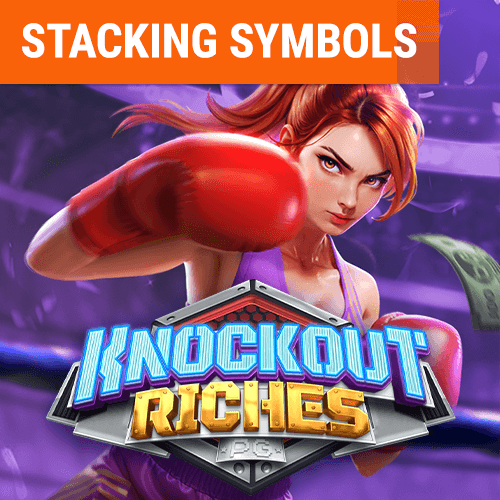
Ruby, the fictional boxer nicknamed the Flaming Rose, provides the setting for Knockout Riches. The free-play game is not a boxing controller or a test of how quickly you tap. It presents five reels, and the middle three can be substantially taller than the reels at the edges. Watching the stacks means following the playable outline, not merely noting where the next boxing animation appears.
Ruby is the story; the changing board is the rule
Open the game with the Play for free control above. The frame contains the game, while the notes below it belong to this website. On the first settled screen, locate the contrast between the end reels and the central stack, then find the provider’s information or rules control. That control is more useful than starting with a fast result animation. It lets you view the official diagrams in a stable order, and it identifies details that may not appear in more than one version or on every visit.
According to the provider, the two outside reels can show from one to three positions, while the central reels can range from four to twenty. Those ranges help distinguish an actual tall stack from a decoration near the top of a short reel. First count the five columns, then look for the extra positions in the three central ones. Do not count a floating text graphic as a playable cell.
To orient yourself after leaving the information panel, start with a familiar board edge. Count the columns rather than the artwork across the top. When a number is visible beside a symbol, check whether that number lies inside the board or in a separate status area. This can clear up a surprisingly common mistake: reading a single decorative or numerical marker as though it takes the place of an ordinary symbol in the grid.
Stacked Symbols and free spins are separate rules
The provider describes a Stacked Symbols feature linked to collecting qualifying symbols. This is how more symbols can be stacked, rather than an action the reader performs by tapping the boxer. It also describes five free spins triggered by two Scatter symbols. A taller column and a Scatter trigger can both be discussed in the rules; they are not different names for the same event.
Picture an edge column with two playable positions next to a much taller central column, then compare that diagram with an illustration of two Scatters. The contrast makes the tasks clear. In one image you examine the playable height and the relevant stack; in the other you identify the icons that open a distinct mode. The position of Ruby’s portrait does not decide which condition you are reading.
The example is hypothetical. It is useful because you can examine one change without claiming to know what will happen on a later spin. If the official rules show two or more steps, read them in order and compare the same part of the board each time. A change of position, a new symbol or a changing number may all be visible at once; note them separately instead of inferring one from another.
An easy way to read the whole stack
Pick an outer edge and follow the first three column borders up to the top of the board. If the reels change height, compare that same central column after the motion has ended. A number or ring-side graphic may appear during a transition without adding symbols to that reel. Focus on the actual outline and use the official rules for anything the animation leaves unclear.
Before enlarging an image or opening full screen, look for whether the demo’s own controls remain visible. Depending on the frame, the underlying website may scroll while the embedded player remains at a fixed size. Reopen the rules if a graphic has covered the board and compare it with a version where the edges are visible. You can learn a layout from a still example without having to keep the reel animation running.
Use the game rules as a reading checklist
- Identify the starting grid and the contrast between the end reels and the central stack; that is your stable reference for later images.
- Find the provider’s drawing or description that shows the main feature. Compare the starting condition with the screen that appears once the feature begins.
- Read the actual labels beside a number before assuming it is a multiplier, a counter, or a simulated result.
- Go back to the diagram if a regular animation makes the relevant change hard to see. If the description and the interface differ, follow the information for the version actually loaded.
It is helpful to finish this checklist by putting the feature into a single sentence in your own words. Begin with the part that changes and then say where you saw it. If your sentence only mentions a colorful effect, return to the diagrams for the symbols or placements that explain it. This is a better way to test understanding than treating the size of a simulated amount as a measure of how clearly the feature worked.
What the numbers mean in a virtual-credit frame
The result amount for one simulated event differs from the running demo balance. The result is what the interface shows for an event under the rules. The balance is the current virtual total for this session, and another readout may show how far a feature has progressed. Check the surrounding text to tell them apart. None is an offer of money or a cash prize that can be withdrawn from this page.
A small set of screenshots or observed rounds cannot tell you when the same feature will appear again. An outcome that looks close to a rule illustration is not a prediction about the next one, either. You can close the player after finding the part of the display you came to read. There is no need to change settings or continue the session just to get a particular board on screen.
Reference and availability
The publisher’s official Knockout Riches reference describes the named features and layout. Use that reference together with the information panel in the particular version of the game you can access. The provider controls the free-play frame. If it does not load, consult the written rules instead of submitting payment details or following a link that claims to unlock the demo. Adults only; see the website policies.