About Funky Fortunez Demo: Find the Prize Symbols
This is a third-party free-play demo, not real-money play on Demo slot pg. Availability and access checks are controlled by the provider. Demo results do not predict future outcomes.
Funky Fortunez uses a four-by-four board where a position can carry a mark even after the ordinary symbol in it changes. When the same position is activated again, the game can turn it into a Prize symbol. Read this free-play demo by tracking cells, not by trying to recognize every new symbol or taking the largest number on the screen as the current result.
Find the sixteen cells inside the street-art frame
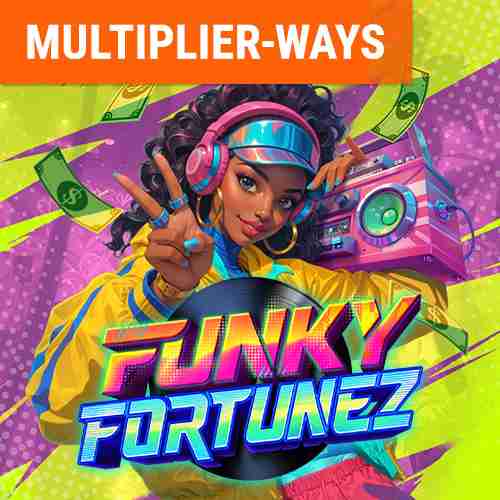
Choose Play for free in the demo player. Funky Fortunez uses graffiti, microphone imagery, and a hip-hop performance theme. The artwork directs attention toward the center, but the grid itself is simple: four columns and four rows. Count sixteen positions on the starting board and pick an easy landmark, such as the top-left cell. This is a game about changes to positions, so a clearly identified cell is a better reference than a decoration outside the board.
When an animation highlights a combination, pay attention to the cells it crosses. A new image can later appear in the same cell. The ordinary symbol describes what is there now; a mark can tell you about what already happened at that board location. They are not the same thing. Check the help panel for the difference before trying to work it out from the colors or the soundtrack.
From an ordinary cell to a marked position
The English information sheet describes two activations. The first marks the position. The second can turn that marked position into a Prize symbol. The bookkeeping is tied to the position that activates, not to a microphone or another motif traveling from one cell to another. If the same ordinary icon appears in another column, that alone does not tell you that the earlier cell has been activated again.
To picture the distinction, imagine a highlighted cell in the second row and third column. Notice that coordinate first. If the art there changes but the cell still bears a mark, you can identify the previously marked location without having to remember the old symbol design. If a separate icon enters a different cell, do not make the two events equivalent just because their colors match. This hypothetical example is about reading the grid, not forecasting its next arrangement.
Before treating a disc as a result, check when it is evaluated
PG SOFT’s rules say Prize symbols are evaluated when the main-game spin reaches the end of its winning-combination sequence. The number on a disc and the result figure displayed after the spin are therefore different pieces of information. One is associated with the symbol on the board; the other shows what the game has calculated so far or at the end. Do not assume that a number printed on the grid has already been applied to the current virtual balance.
Read a feature example from left to right if the rules show multiple screenshots. Locate the highlighted cells in the first picture. Next, compare them with the marked or filled positions in the later picture. Save the total shown in the final image for last. This comparison makes it possible to see how a position changed without having to infer the change from the total or follow a fast burst of visual effects.
Gold and Platinum belong to a separate upgrade step
The Prize Upgrade feature can change a Prize symbol into a Gold or Platinum version before it awards a value. Notice the order: first there must be a Prize symbol to discuss, then its state can change. A gold-colored stage decoration is not a Gold Prize symbol. Likewise, the appearance of an ordinary disc does not establish that its display will become Platinum. Use the actual disc artwork and the label in the game’s rules.
If two discs are visible, compare them individually before interpreting the virtual-credit result. They might not have the same state or number. A state can also change from one screenshot to the next while remaining in the same grid position. Tracking the location keeps those two observations separate: which cell you are looking at, and what kind of Prize symbol it holds at that point.
How the free-spin sequence changes what stays visible
The official guide describes ten free spins when three Scatter symbols appear and two additional spins for each extra Scatter in that trigger. The free-spin rules also say that marked positions and Prize symbols remain on the grid until the feature ends. This gives a previous board state a visible presence in the next free spin. Read the remaining-spins label and the persistent positions separately.
Once an upgraded disc has been evaluated, the rules describe Gold and Platinum versions reverting to ordinary Prize symbols for the next free spin. That change does not mean the cell was never marked or that the position must have moved. Look at the cell and its label in both snapshots. A persistent position can still contain a symbol whose current presentation differs from the preceding spin.
A compact checklist for reading the demo
Start by pointing out the four-by-four grid. Next identify a marked cell in the official example and note what makes it different from an ordinary position. Then find a Prize disc and compare its normal appearance with Gold and Platinum versions. Last, check a free-spin example to see how long the grid preserves marked positions. These observations explain the distinctive presentation without requiring a long session.
When the board is too small to inspect, go back to the static images in the information panel. A still image makes it easier to map the same row and column across several states. It is unnecessary to wait for a particular upgrade. A brief demo cannot tell you how frequently an upgrade will appear or whether a later result will resemble the example.
To check your understanding, compare two neighboring cells in the same row. If one retains a position mark while a disc changes in the other, identify the two states separately. The left-to-right order of those cells is a useful way to keep them straight when the color effects overlap.
Sources and virtual-credit availability
The arcade artwork and feature overview are described in PG SOFT’s Funky Fortunez introduction. The marked-position, upgrade and free-spin rules come from the English game information. The original discovery listing is retained for attribution. The provider controls demo availability; the virtual credits have no cash value. Read the website policies for service details.