About Rise of the Sun God Demo: Sun and Symbols
This is a third-party free-play demo, not real-money play on Demo slot pg. Availability and access checks are controlled by the provider. Demo results do not predict future outcomes.
The free Rise of the Sun God Demo puts PG SOFT’s version of Apollo above a six-reel game with symbols that can change from silver-framed to gold-framed and then to Wild. The details matter because a large tile, a glowing border and a highlighted multiplier are three different things. On a first visit, start with the artwork and then follow just one marked symbol through the end of a cascade. The player uses virtual credits, and there is no deposit or prize attached to the preview.
Apollo and the images on the reels
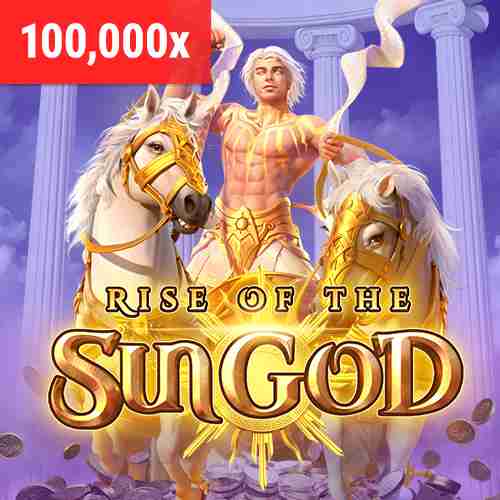
The developer’s cover places the sun god between white horses, which gives the entrance screen the feel of a triumphal scene. The reels pick up the mythological theme in smaller details, including a lyre, a vessel and a green wreath alongside familiar card ranks. A reference to Apollo explains why those pieces of art work together, but it doesn’t tell you which icons count as special. The readable names and categories are in the in-game symbol table.
The lyre is a good tile to begin with because its shape is easy to pick out from the letter ranks. Find it on a board at rest and then compare it with a label in the rules. The ordinary symbol has a recognizable picture. If that same kind of picture appears in a frame, look at the frame separately; the picture identifies the tile and the border can identify a state. Approaching the demo that way is more useful than watching for a general flash of gold.
Six reels and a board that changes within one spin
The developer describes six reels and up to six rows. Some images fill two or more spaces vertically, which makes the board look less regular than one made entirely of single squares. In the published rules, a tall symbol still counts as a single symbol for the result calculation. The height of the artwork isn’t a multiplier, and it isn’t a reason to count several copies of the picture. Look at the image’s boundaries before deciding whether you’re seeing several symbols or one tall one.
Qualifying combinations start on the left and run through adjacent reels. After a winning step, the matched symbols can clear and other symbols fall into place. This is the flow PG SOFT classifies as collapsing reels. The replacement board belongs to the current spin, and is not necessarily a completely new grid. You can follow the action by picking a position in one of the middle columns and checking which parts of the board moved around that position.
From silver to gold to Wild
PG SOFT calls its transformation rule Wilds-on-the-Way. A silver frame can occur around certain tall ordinary symbols on the second through fifth reels. The frame is not a Wild by itself. If that silver-framed symbol participates in a winning step, the rules can replace it with a different ordinary symbol in a gold frame after the refill. A gold-framed symbol that participates in a later winning step can become Wild. Keeping the picture and the border separate helps make sense of a replacement where both change together.
Try reading it as a sequence of snapshots: an unlit board, one highlighted combination, and a fresh arrangement. The game may move between those views quickly, so don’t try to keep track of the whole screen at once. The first frame can be understood without watching the feature finish. A brief preview might show no relevant transformation at all, and the developer’s diagrams can still illustrate the order.
Wilds Blessing is a different transition
The studio describes a second event called Wilds Blessing. It can transform three silver-framed symbols directly into Wilds at the start of a spin. This is distinct from the silver-to-gold-to-Wild path that depends on a qualifying result and a later refill. The visible difference is the timing: the Blessing is shown as an event at the beginning, rather than as a frame changing after a winning step has finished.
The Wild itself substitutes for ordinary symbols, not for Scatter. The published rules also place Wilds on the middle four reels rather than the outside two. A mythological figure can be part of either presentation, but the two named symbols still have different functions. To read the screen, use the label in the information panel and the location of the tile, not just the face or the size of the image.
The five multiplier steps
Below the reels is a row of five multiplier labels. In the main game the row begins at one and steps up with qualifying cascades, reaching five on later steps. The highlighted value describes the current step, not a new credit balance. For example, if the first step qualifies, the second can apply the next value. If another qualifying step follows, a third label may become active. The changing highlight is easier to follow than trying to add every animated result as it appears.
The free-spin feature uses a different version of the same row: three, six, nine, twelve and fifteen. Four Scatter symbols can start the feature with twelve free spins, and additional triggering Scatters can add spins. The highlighted multiplier and the remaining-spins number sit near the same part of the interface, but the first describes calculation and the second describes how much of the round remains. Reading the labels is enough; you don’t need to keep playing to see every value.
A focused first visit
Open Play for free and let the Apollo artwork fade into the board. Read the framed-symbol rule, locate the five-part bar and use the lyre or another distinct tile to get your bearings. If you open the demo in a narrow window, make sure the label below the reels is visible before checking how the symbols fall. A tall tile in the center and a highlighted number below it should remain two separate observations.
If you stop after reading the board once, you will already have seen the design’s basic structure. The rules panel can show what the symbols do without waiting for a particular sequence. Displayed figures are virtual, and a result in this preview neither predicts a later session nor changes the rules of any other version of the game.
Source and availability
The official Rise of the Sun God game information documents the Apollo artwork, framed symbols and multiplier steps. The existing listing records the original availability reference; the embedded free-play game comes from the provider. If labels differ here, follow the player’s own current rules. The provider controls availability and supported languages. This preview is for adults and uses virtual credits. See the website policies for more information.