About Majestic Treasures Demo: Read the Cluster Grid
This is a third-party free-play demo, not real-money play on Demo slot pg. Availability and access checks are controlled by the provider. Demo results do not predict future outcomes.
The royal vault in Majestic Treasures is built around a five-by-five board. When you read a highlighted group, look for symbols touching horizontally or vertically. That is the connection pattern the game uses, so a diagonal pair alone does not make the same kind of group.
Get your bearings in the demo
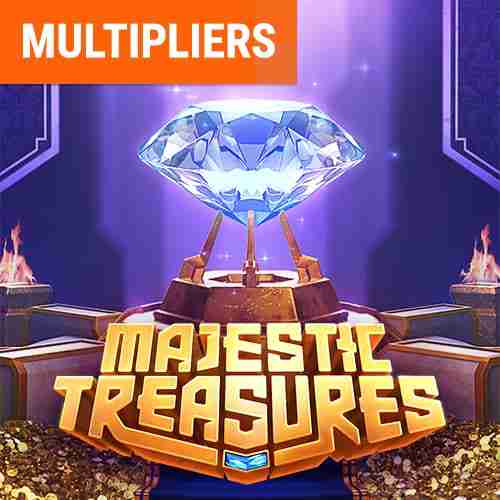
Before trying a round of Majestic Treasures, check that the free-play screen shows the exact title and then look for the five-by-five grid and the way the guide draws connections between matching symbols. The symbols on its opening screen can help you recognize the title, but they are not a substitute for the rules in the provider’s information menu. The jewel and vault design establishes the theme, while the rules identify the positions that belong to a cluster. If you are reading on a phone, return from the information panel before comparing the board with the result display.
Majestic Treasures places its jewel artwork in a royal-vault setting, but this layout is best approached as a grid rather than a row of traditional paylines. The board has five columns and five rows. Pick any corner as a fixed edge and then find a group in the provider’s example, paying attention to the direction of the connections.
Look for symbols touching at the edges
The official explanation describes groups of four or more matching symbols touching by a horizontal or vertical edge. That gives you a simple rule for reading a highlighted arrangement: trace the cells sharing edges. A pair touching only at a diagonal corner does not supply the same kind of connection in that example.
Consider the difference between a vertical chain with a branch on one side and two icons touching only at their corners. The chain can still connect step by step through shared edges. With a diagonal gap, you need another matching position to create that path. This is about reading the example, not selecting an outcome.
A different cue changes what to look for
The game’s introduction also names Wild transformation and the removal of poker-rank symbols as additional mechanics. Those changes affect which artwork is visible in the grid. Start by identifying the cluster on the original board, then compare it after the transformation or removal. A changed symbol should not be confused with an extra cell.
The free-spin feature has changing multipliers shown separately from the connected group. Look for the display above the board that the provider describes. The multiplier gives you a number to read while the group gives you positions to trace. The five-by-five grid does not become larger simply because the number displayed above it changes.
A worked example, and a contrasting case
Imagine consecutive cells forming an L shape, with three matching positions in a row and one touching the row vertically. Trace the path from one end to the other using the shared edges. You can see why a group need not be a straight line to match that example in the rules.
Now imagine four identical symbols in a staircase where each one touches the next only at a corner. The pattern contains the same count, but the shared edges are missing. Do not treat the images as a connected cluster just because they look close together. Use the provider’s diagram to confirm what the highlighted outline actually includes.
The two situations are reading examples for Majestic Treasures, not a promised set of outcomes. In a free-play session, some of the controls and illustrations may be easier to see than the effects themselves. If an example is unfamiliar, pause at the information menu to compare its starting condition with the state shown on the screen. Do not use a previous result to guess what the next round will display.
How to read a result without guessing
First read the rule for the shape of a group. Count the number of symbols that are connected before looking up the values in the guide. Then look at the transformation examples. They tell you which positions were changed and let you confirm whether the board is still showing the same group of images.
Finally locate the free-spin multiplier display and compare it with an amount reported for a completed simulated result. Those numbers serve different purposes. When the interface shows multiple values, use their labels and positions to identify them. The highlight inside the grid is the most direct evidence of which cells made up the cluster.
What difference matters most? The crucial comparison is shared edge versus shared corner, not bright symbol versus dull symbol. The visual theme makes the vault attractive, but the grid geometry is what you need when the game highlights a group. Check the source image under the rules if the animation moves faster than you can trace it.
Do I need to trigger a feature to see these rules? No. The examples let you practice reading an edge-connected group and a non-example without waiting for either outline to form. That makes it possible to use the demo as a short reference. The number of rounds that show no feature tells you nothing reliable about the next board.
What the numbers in this demo represent
Majestic Treasures uses a simulated running balance. A numeric value above the board or a result tied to a cluster is part of that interface, not something paid by the site. The practical takeaway is knowing where and how to trace a connected group, and where the software separately reports its effects.
The balance in Majestic Treasures is a simulation. Read it as a running display while using the game, not as a payout or a measure of how often a special event should happen. A result amount describes one event under the provider’s rules, whereas the balance is about the current session. If you can recognize the difference on the free-play screen, the guide has done its job even if no unusual round appears.
Source notes and availability
This guide uses PG SOFT’s official Majestic Treasures information for the game rules. The official game catalog page identifies the title. The existing demo listing is credited for discovery, not for this text. The free-play frame is hosted by the provider and may have its own availability or language options. See the website policies for more about the service.