About Kraken Gold Rush Demo: Sea-Monster Preview
This is a third-party free-play demo, not real-money play on Demo slot pg. Availability and access checks are controlled by the provider. Demo results do not predict future outcomes.
The free Kraken Gold Rush Demo turns a sea-monster story into a square-edged grid with a Wild that stays in the middle while surrounding symbols change. The game also distinguishes a short run of qualifying rounds inside one spin from the multiplier steps shown during free spins. Track the central creature first and the counter second. The embedded player uses virtual credits only; no displayed gold or other balance is cash.
From the Deep Tide Seas to the board
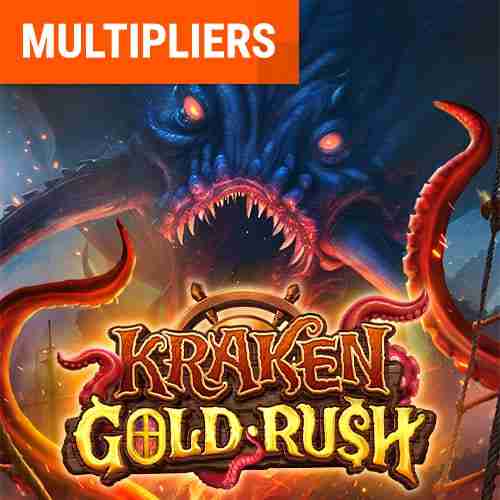
PG SOFT sets the story in the Deep Tide Seas. A Kraken has made the once familiar waters dangerous, and the game’s crew enters the story in search of a bounty. That setup explains the dark water, tentacle imagery and maritime title. It does not ask the player to chart a course or take control of a ship. The part of the screen that responds is the game grid, and the information panel explains what its symbols do.
The way the creature is used is more specific than simply putting a sea monster on the cover. The developer names a Wild Kraken as a marker inside the board. Find the named marker during a quiet part of the interface. A tentacle in the background may help tell the story, but it is not a second copy of the Wild and should not be counted as one.
The center gives you a steady reference
The studio describes a board six symbols wide and five deep. Its published launch material places the Wild Kraken in the middle, on the third row across the central reel area. The important comparison is the creature’s position before and after surrounding pictures change. The documentation describes it as sticky for the duration of the spin. That kind of persistence is one of the clearest differences between this game and a plain board that changes every cell at once.
Try to keep the central position in mind as a visual reference. Look at the cells immediately next to it before the animation starts. When the surrounding symbols move, compare them with the fixed center rather than following the artwork all the way to the edges. The Wild’s persistence makes it possible to find the same part of the grid again. It does not establish a particular result just because a symbol you recognize is still visible.
A winning round is not necessarily a new spin
The launch material describes several qualifying rounds within an individual spin. After one stage changes the board, the next arrangement can still belong to the same spin. That is why the story can seem to move through several short beats even if you have not touched the controls again. Focus on whether the current arrangement has finished resolving, rather than counting every motion as a separate spin.
The developer distinguishes the final main-game calculation from the way a feature advances. In the launch examples, a main-game spin with at least three qualifying rounds can use a five-times multiplier once no further combination remains. The count is of qualifying rounds in that already-started spin, not the number of times a button was pressed. It is a rule about how the game presents and calculates the current sequence, not a forecast for a new one.
Free spins use a step counter of their own
Three labeled Scatters can start the documented feature with ten free spins, and extra triggering Scatters can add to that initial count. During the feature, the studio describes a multiplier that can move up a level after each group of three qualifying rounds. The wording matters: a level change is not the same as adding one directly to the numerical multiplier. Check the current label to know which value the game is showing at that level.
Imagine the interface presents a sequence of highlighted stages in the feature display. The number of qualifying rounds describes why the highlight can move; the number at the highlighted stage describes the multiplier. A third label can show the remaining number of spins. None of these values is interchangeable. If you only look at the largest number near the board, you could miss whether the game actually advanced a stage or only updated the duration counter.
Two uses of the number three
One useful distinction on this title is that three Scatter symbols and three qualifying rounds refer to different events. The Scatter count is used to identify a feature trigger on a board. The qualifying-round count describes progression while a sequence is already running. Seeing three visible pictures with the same theme does not necessarily mean either condition applies. Look for the Scatter label at entry and the feature’s own qualification state after entry.
These rules make it possible to explain the screen without speculating about how long it might take to show a particular state. The feature can be understood by viewing the launcher’s rules or the developer’s announcement. A short visit that shows only the ordinary board is still enough to see how the sticky position acts as a visual anchor. There is no need to wait for a multiplier level or a feature screen.
On a still image, mark the central Kraken once and look for the label used for the completed round. Those two details are sufficient to compare the progression across frames without relying on the larger story art.
Make the free preview easier to read
Select Play for free, let the opening artwork settle and find the information panel. Identify the Wild Kraken, the boundaries of the central area and the label used for the Scatter. On a narrow screen, use the player’s available view controls if needed to see the row of counters and the whole grid together. If you try a spin, check whether the middle marker stays when neighboring parts of the board change.
The nautical art and the animated values are presentation. A displayed result in this virtual-credit preview cannot be withdrawn and does not provide a prediction about later results. The best thing to take from the demo is a clearer understanding of which thing the interface is counting at each point.
Sources and availability
PG SOFT’s Kraken Gold Rush announcement describes the setting and feature progression. Its published launch notes supply further detail on the sticky Wild and the main-game calculation. The existing listing references this demo availability source. The provider supplies the embedded game and controls access, language and current rules. This adult preview uses virtual credits only. See the website policies for more information.