About Museum Wonders Demo: An Exhibit Preview
This is a third-party free-play demo, not real-money play on Demo slot pg. Availability and access checks are controlled by the provider. Demo results do not predict future outcomes.
The free Museum Wonders Demo starts outside a museum, then moves to a set of reels where one framed object can reveal something new. The key is the Mystery symbol: it combines an underlying picture with a multiplier, and a qualifying result does not simply clear it away. The free-spin feature adds another layer by gradually filling designated positions with Mysteries. This preview uses virtual credits only and does not accept deposits or pay cash.
Reading an exhibit on the opening screen
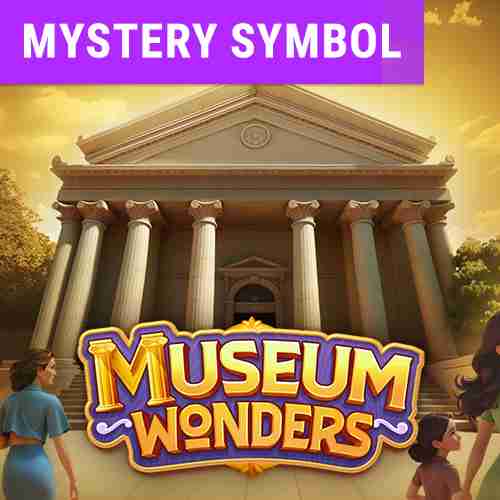
The developer’s cover shows a columned museum façade, with visitors climbing the steps. The playable screen carries that setting indoors. Look at the transition as a change in viewpoint: the opening façade sets the place, while the grid inside shows framed pictures the game can evaluate. A visitor can appreciate the visual theme without taking every frame as an information label. The named categories in the symbol panel are the reliable way to tell which images have a special function.
PG SOFT depicts the Wild as a framed portrait of a person wearing glasses. The Scatter uses the image of a museum entrance or arch. Both fit the exhibit theme, but they do different jobs. The Wild can stand in for ordinary symbols and is not a substitute for Scatter. Compare those two examples in the information screen before looking for the Mystery symbol, which is separate again. Three kinds of frames or artwork can share a museum setting without representing the same rule.
The middle reels are where the Mystery sits
The published layout has five reels. The three middle reels are taller than the outside two, and the Mystery symbols described in the manual appear in these middle reels. This narrows the useful area to inspect during a first look. Identify the outer columns, then turn your attention to the taller ones. You are not looking for an extra reel beyond the display; you are looking for a picture whose meaning can change while it occupies a position inside the grid.
The asymmetry makes it easy to find your place again if the symbols are moving. Look for the edge of the center section rather than counting every square from top to bottom. Then, if a marked picture appears, compare it with its description in the panel. The visual position can tell you where a Mystery could appear, but its job is still determined by the named rule rather than by location alone.
A Mystery has a picture and a value
PG SOFT describes the Mystery as containing a selected ordinary symbol and a two-times multiplier. The symbol inside can count toward a qualifying result; the multiplier is a separate part of the calculation. In the developer’s diagrams, both aspects are visible close together on the board. Read the picture first to know what matched and the accompanying value second to understand how the result is shown. A numeral in a frame is not itself a replacement for any shape on the neighboring reels.
When a Mystery participates in a result, the manual describes it remaining on the reel through the spin and revealing a new contained picture afterward. That’s what makes it worth tracking in the same place. An ordinary picture nearby may be cleared, while the frame itself remains and changes what it contains. If you were watching only the color of the highlight, it would be easy to miss that the symbol stayed put even though the image did not.
Why a number can remain after the tiles move
A qualifying Mystery can add its value to the multiplier used for that result, and the main-game display can retain a total while the rest of the spin resolves. A later qualifying Mystery in the same spin can add to the total. This is a useful example of two different kinds of persistence: a symbol remains in a position on the grid, while an accumulated value remains visible below the board.
For a simple reading exercise, identify which of the framed symbols actually participated. Then compare the multiplier label before and after the board advances. The manual ties the contribution to winning Mysteries, so you should not assume an inactive or unrelated frame made the total larger. If a normal symbol instead changes somewhere else on the board, that does not establish that the multiplier changed. Read the labeled total when it settles, not the animation as a whole.
The free-spin feature builds a denser display
The provider describes three Scatter symbols opening ten free spins. A Mystery can be added at the beginning of a free spin to an eligible position in one of the middle reels. As the feature advances, the available positions can fill. That is why the last illustrated state does not need to add yet another Mystery: the game can reach a point where its eligible positions are already occupied.
The rules also distinguish the multiplier in this feature from the regular spin. Values collected from qualifying Mysteries can remain until the free-spin feature ends. The remaining-spins label therefore answers a different question from the multiplier total and from the number of frames on the board. Counting only one of those figures is not enough to describe the whole state. The illustrations in the developer’s document are a useful way to compare the same stage across several views without waiting for it in the preview.
A short view of the gallery
Select Play for free, let the museum exterior fade, and open the information screen. First identify the Wild portrait and entrance Scatter, then find the Mysteries in the taller area. If you try a spin, pick one center position to follow and wait for the labels to settle. A smaller phone window may make the contained pictures hard to distinguish, so adjust the view if a full-screen control is available.
You do not need to see a fully stocked set of Mystery symbols to understand why this game is built around exhibits. A single framed tile can show how an image and a label share the same position. The figures in the free game have no cash value. Any apparent pattern you see in a brief preview does not predict a later game.
Source and availability
The feature and artwork are described in PG SOFT’s official Museum Wonders game information. The existing page uses this demo availability reference; the provider serves the embedded game and controls access, labels and language. When the live player describes a rule differently, use that version’s current information. The virtual-credit preview is for adults. See the website policies for more context.